Choosing care
How to Choose a Preschool in Hebbal: A Parent’s Visit Checklist
A calm, practical checklist to help you compare preschools based on what your child and family actually need.
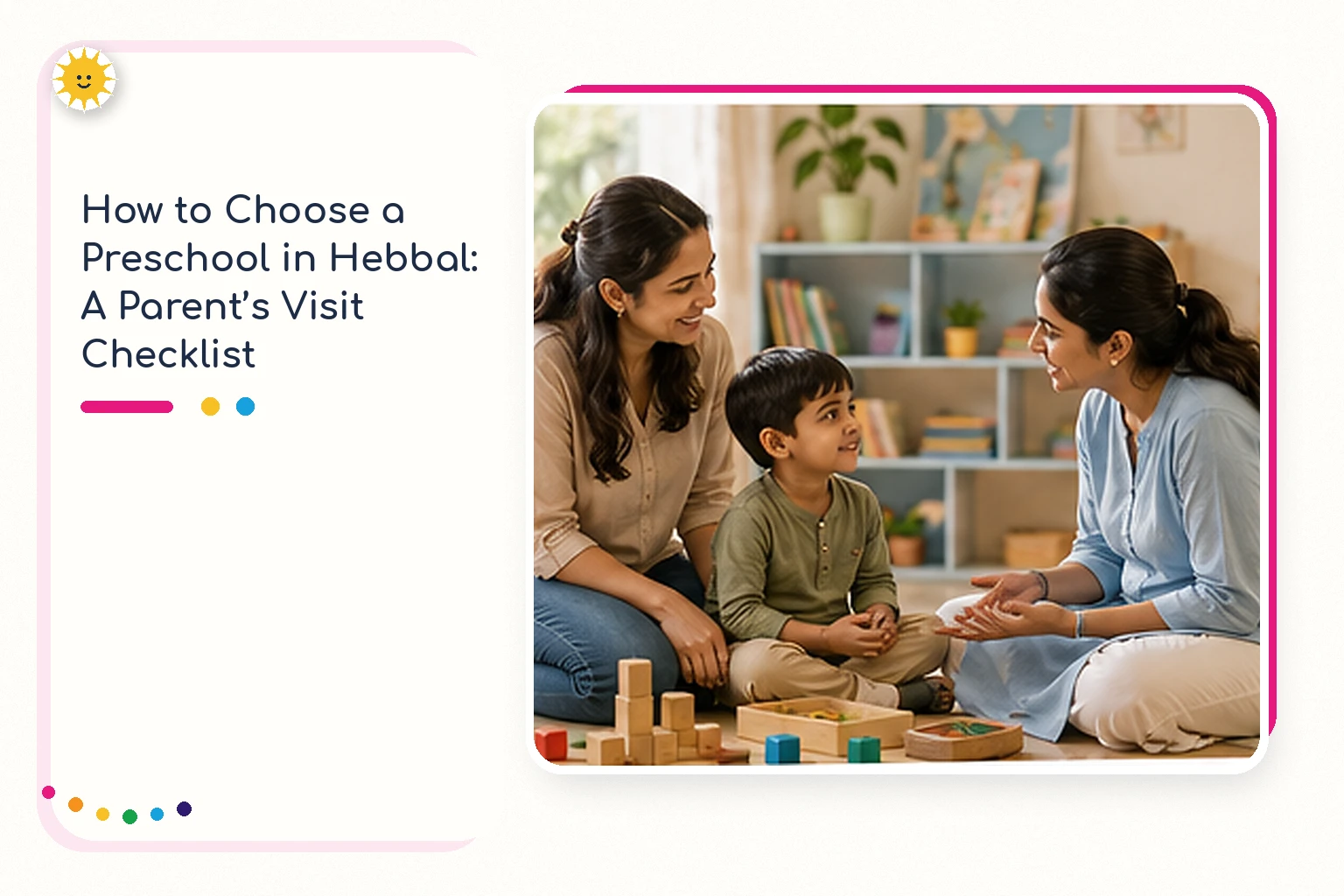
Choosing a preschool can feel heavier than it needs to. Every school has photographs, programme names and promises. A visit becomes much easier when you know what to observe and which questions matter for your child’s everyday experience.
The best preschool is not simply the one with the longest feature list. It is the place where your child can feel safe, understood and interested—and where the daily routine works for your family.
Before the visit: decide what your family needs
Write down your non-negotiables before comparing schools. This keeps a polished tour from distracting you from practical needs.
Consider:
- Your child’s age, temperament and previous group-care experience
- The hours you genuinely need, including difficult workdays
- Travel from home, work or a caregiver’s location
- Whether you need preschool only, daycare only or both
- Meal, nap, allergy and toilet-support needs
- How you prefer the school to communicate with you
If two adults share drop-off and pickup, check the route at the actual times you expect to travel. A centre that looks close on a map may feel different during Hebbal traffic.
Start with safety you can see
Ask the school to show you its safety routines rather than accepting a general reassurance.
Look at:
- How adults and visitors enter the premises
- How children are signed in and released
- Who may collect a child and how authorisation is checked
- Whether rooms, play areas and washrooms are supervised
- How the team handles an injury, illness or emergency
- Whether emergency contacts are kept current
- How parents are informed when something unusual happens
At Tender Moments Hebbal, CCTV covers all areas with live access through the school app, and children are released only to a parent or authorised escort. During a visit, ask to see how these processes work in practice.
Observe how adults speak to children
A calm room does not have to be a silent room. Young children learn through movement, questions, play and repetition.
Watch how educators respond when a child:
- Needs help
- Does not want to join an activity
- Makes a mistake
- Is upset at separation
- Wants the same toy as another child
- Needs more time to finish
Warm, respectful interaction matters more than a rehearsed activity performed for visitors. You are looking for adults who notice children, get down to their level and guide without shaming.
Ask who will be with your child most often. Staff titles matter less than understanding the actual care arrangement during learning, meals, toileting, rest and late-day daycare.
Look beyond worksheets
Preschool readiness is broader than reciting letters or numbers. Children also practise listening, speaking, taking turns, moving confidently, solving small problems and caring for their belongings.
During your visit, look for:
- Open-ended play materials
- Books within children’s reach
- Art, music, movement and pretend play
- Opportunities for conversation
- Fine-motor activities such as blocks, clay or threading
- Space for active play
- A balance between guided activities and child-led exploration
Ask the educator what children are learning through an activity. A clear answer should describe the skill or experience—not only the finished craft.
Understand the whole day
A timetable should tell you more than the start and finish times. Ask how the rhythm changes across the day.
Useful questions include:
- What happens when a child arrives?
- How long are activity blocks?
- When do children eat, rest and play?
- Is there a quiet space for a tired child?
- What happens after the preschool session ends?
- Are late-afternoon activities suitable for children who have already had a long day?
- How are different age groups supported?
If you need extended care, visit or ask about the daycare period—not only the morning preschool programme.
Tender Moments Hebbal is open Monday to Friday from 8:30 AM to 8 PM and Saturday from 8:30 AM to 4 PM. Families should still discuss the schedule that is suitable for their child rather than assuming the longest available day is automatically the best fit.
Ask about meals, rest and personal care
Every family handles food and routines differently. Ask:
- What meals and snacks are offered?
- How are allergies documented and communicated?
- Can food be sent from home?
- How does the school respond when a child eats very little?
- Where and how do children nap?
- What should families send each day?
- How are toileting and diaper changes handled?
- How are clothes and personal items kept separate?
At Tender Moments, the daily meal and snack routine, menu approach, allergy handling and food-from-home process are explained during the school visit.
Check how the school communicates
Parents need enough information to understand the day without being overwhelmed by constant notifications.
Ask what you can expect to hear about:
- Meals and naps
- Activities
- Mood or settling
- Toileting or diaper changes, where relevant
- Injuries or illness
- Events and items to bring
- Developmental concerns
Also ask whom you should contact with a routine question and whom to contact when something is urgent.
Notice how your child responds
One short visit cannot predict the entire experience, but your child can still give you useful information.
Notice whether your child:
- Becomes curious about the room or materials
- Responds to an educator’s approach
- Finds a comfortable place to pause
- Is allowed to observe before participating
- Is treated kindly when hesitant
Do not expect instant excitement. Some children explore immediately; others need repeated, low-pressure exposure.
Compare after the visit
After each tour, record:
- What made you feel confident?
- What remained unclear?
- How did the adults interact with children?
- Could you imagine the routine working on an ordinary Monday?
- What did your child appear to need?
Avoid deciding only from décor, gifts, discounts or one staged activity. The everyday relationship between children, educators and families is the stronger signal.
What parents can do today
Choose your five non-negotiables, save this checklist, and visit no more than two or three schools at a time. After each visit, write your observations before the details begin to blur together.